
How close is too close for COVID-19? Six feet of separation may not be enough
Even six feet of separation might be too close for comfort in the new norm of COVID-19.
Using a special “cough chamber,” Ontario scientists measured how far and fast influenza particles can be propelled through the air in a cough jet. According to the study, when a human infected with seasonal flu coughs in the direction of someone standing six feet away, viral droplets will reach that person within three seconds, and will “continue to projectile forward well beyond the recommended six feet.”
Researchers at the University of Western Ontario experimented with seasonal influenza, not the virus causing COVID-19, but the findings could have implications for the six-feet (1.8 metre) social distancing rule.
Two metres is practical
National Post spoke with co-author Eric Savory, of Western’s department of mechanical and material engineering. Any degree of separation will mitigate the spread of COVID-19, Savory says, though there’s no hard evidence as to where the six-feet edict came from or what it’s based on. Here, Savory explains the study and its findings:

“Clearly the farther away you are — three metres, four metres — the better. But two metres is certainly better than one metre.”
Getty Images
Savory: In a way, this is why we choose to do this project. There has been some guidance that says one metre is fine, some have said three feet, some have said six feet. It’s not based on any evidence.
We partnered with virologist Samira Mubareka at Sunnybrook Hospital in Toronto. Essentially what we were looking at was to recruit a bunch of people who were on campus at Western who had been referred to us showing flu-like symptoms. They were all pretty sick, but we managed to get some of them across campus to our lab.
So, we measured their coughs and we sampled their coughs and we then asked them to come back after a month and we did the same measurements again. Then we had a group of people who were healthy that we also recruited across campus. They were in the age range of 18 to 30.
We were just looking to see what differences there might be between coughs, and how far these coughs could travel. Because no one has ever measured far away from the mouth. Everyone who has done studies, as far as we can see, has measured very, very close to the mouth. Which of course is not that interesting from the point of view of transmission.

An illustration of the cough chamber.
Illustration by Frank Neufeld / University of Western Ontario
The cough box is basically a box that’s a two-metre cube, and we had a hole in one end and people came and they rested their chin on it, a bit like the device an optician uses when you go to have your eyes tested.
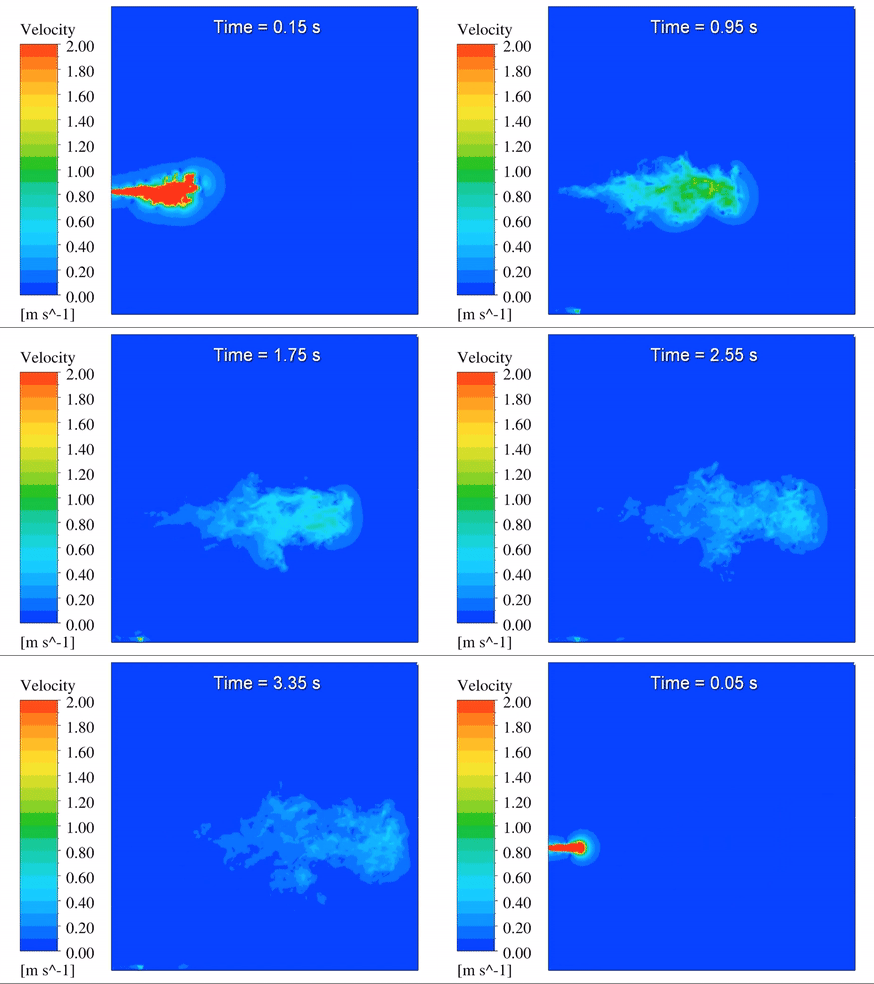
And then they coughed into the box. We had to enclose it, for biosafety reasons, because they may be carrying influenza. And then we had a system of cameras that imaged a laser light sheet along the plane of the cough — you can imagine the cough is coming out like a vertical plane on the centre line. And we were able to track the movement of the cough airflow by introducing very, very fine, micron-sized solid particles into the flow. And we looked at the displacement of those particles, and from that we were able to measure the velocity vectors, the magnitude of the velocity, at about a metre away. So we were quite a long way away from the mouth.
The key findings are that, on average — and this is over many, many different coughs, because there are weak coughs and strong coughs — the air is still moving at about one metre a second, a metre away from the person, which is not insignificant. And certainly it’s difficult to get away from someone who coughs at you if it’s moving at a metre per second, and you’re a metre away from them.
We also coupled this with some computer modelling to then extrapolate farther distances with some confidence. That’s how we’re able to say that two metres away you’ve still got significant air velocity. Two-and-a-half metres away it still could be moving at 200 millimetres a second.
The advice that everyone has been given, which is you should stay two metres away is very sound, in that it’s a practical distance. Clearly the farther away you are — three metres, four metres — the better. But two metres is certainly better than one metre, which is certainly better than being close to somebody.

The cough chamber.
University of Western Ontario
On the findings that 10 per cent of the cough droplets were still in the air at a distance of six feet
This is true, and even farther. The very fine droplets will stay in the air for much longer. I mean, they’re not going to fall to the ground by gravity. They will eventually get dispersed.
The question I can’t answer at the moment, and the questions virologists can’t answer about COVID-19, is that we don’t really know exactly what the dosage is that you need to inhale to become infected. So there may be very fine droplets there that may contain virus that you may inhale, but it may not be in a sufficient dosage for you to be infected.
Two metres is practical. If you start saying to people they’ve got to be three, four, five, six metres away — sure, not coming into contact with anybody is the safest thing to do. But we have to keep society functioning, obviously.
But it’s not as if any droplets reach two metres and suddenly decide ‘okay, we can’t go any farther guys.’
• Email: skirkey@postmedia.com | Twitter: sharon_kirkey


About author


Recent Comments