
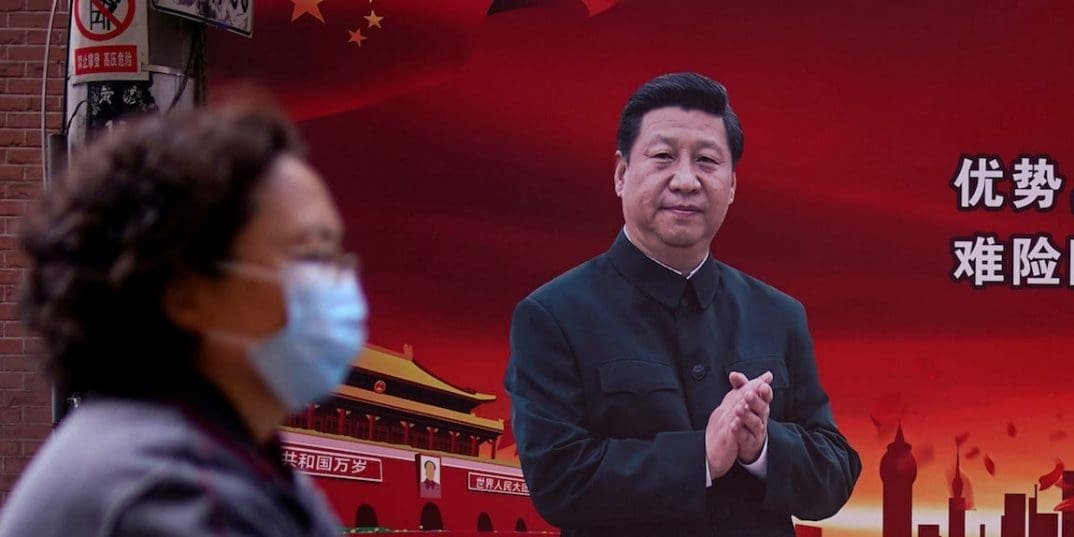
China knew the coronavirus would become a pandemic in mid-January, but for 6 days claimed publicly there was ‘no evidence’ it could spread between humans
- China knew the novel coronavirus could spread among humans and become a pandemic but didn’t tell the world for six days, The Associated Press found.
- A damning memo of a January 14 call obtained by the AP warned top officials about human-to-human transmission and said to prepare for a pandemic.
- But in the six intervening days, China publicly said there was no evidence of human-to-human transmission. The World Health Organization relied on that to direct policy and advise other countries.
- President Xi Jinping finally warned of the severity of the virus on January 20, the same day a top Chinese epidemiologist announced evidence of human-to-human transmission.
- The report appears to substantiate President Donald Trump’s accusations that WHO failed to vet China’s data.
- Visit Business Insider’s homepage for more stories.
For six days in mid-January, China knew the novel coronavirus could become a deadly pandemic while it told the world there was nothing to fear, according to an Associated Press report published Wednesday.
A memo of a confidential phone call with Ma Xiaowei, the head of the National Health Commission, and provincial health officials on January 14, obtained by the AP, said that “human-to-human transmission is possible” and that “all localities must prepare for and respond to a pandemic.”
The call was supposed to convey direct orders about the coronavirus from President Xi Jinping and other top Chinese government officials, according to the AP.
But in the six days that followed, Chinese health authorities publicly maintained that the virus posed a low risk to people.

Xinhua via REUTERS
The Wuhan Health Commission said on January 14, the same day as Ma’s call, that it had “not found proof for human-to-human transmission.”
The next day, Li Qun, the head of the Center for Disease Control and Prevention’s emergency center, told state TV that “the risk of sustained human-to-human transmission is low,” the AP reported.
At the time, the World Health Organization, which relies on countries to provide their own data, took China at its word and offered the same advice to other countries around the world.
“Preliminary investigations conducted by the Chinese authorities have found no clear evidence of human-to-human transmission,” WHO tweeted on January 14.
—World Health Organization (WHO) (@WHO) January 14, 2020
WHO did not immediately respond to Business Insider’s request for comment.
At the time, South Asian countries were looking for — and heeding — WHO’s guidance on how to prepare for the coronavirus, which had already spread to Thailand.
Governments around the world were also considering which preventive measures to put in place and had their eyes glued to China’s response. And for six days, the Chinese government suggested there was nothing to do, the AP found.
Feature China/Barcroft Media via Getty Images
It was on January 20 that Xi finally told people to practice social distancing and avoid travel and that a Chinese epidemiologist, Zhong Nanshan, told state TV that the virus was, in fact, being transmitted among humans.
In the preceding six days, more than 3,000 people caught the coronavirus in China, the AP estimated. This period also marked the run-up to Lunar New Year, the biggest holiday in China, when millions of people around the country travel home to see their families.
If on January 14 Chinese authorities had told people to stay home, wear masks, and refrain from traveling, the number of cases might have been reduced by about 66%, a March 13 paper by scientists at the University of Southampton in the UK found. The paper has not been peer-reviewed.
“If they took action six days earlier, there would have been much fewer patients and medical facilities would have been sufficient,” Zuo-Feng Zhang, an epidemiologist at the University of California at Los Angeles, told the AP. “We might have avoided the collapse of Wuhan’s medical system.”
Reuters
On January 20, China had reported 224 coronavirus cases, but experts have said the true number was likely substantially higher.
On January 17, Wuhan had officially reported about 50 cases, but there were likely 35 times as many, retrospective modeling from Imperial College London found.
The first coronavirus case reported outside China — in Thailand on January 13 — was what prompted the Chinese government to take internal steps to stop the outbreak, the AP reported.
That case spooked Chinese officials, but it apparently was still not enough to alert WHO.
Ju Peng/Xinhua via Getty
As early as December 6, doctors in Wuhan were raising concerns that people could catch the virus from other people.
Perhaps the most famous was Li Wenliang, who began sharing ominous data with fellow doctors but was silenced by the police in Wuhan and made to sign a confession saying he had lied. He later died of the coronavirus, prompting a flurry of online protests against state censorship.
As the authorities in Wuhan squashed Li’s warnings, China’s health authority was quietly mobilizing.
On January 15, on Ma’s instructions, China’s CDC initiated a “level one” internal response, the most extreme response level.
In the following week, CDC officials were dispatched across the country to train health workers, accrue funds, collect data on the virus, and supervise lab testing, according to the AP. Airports and bus and train stations in Hubei province, where Wuhan is, were told to check people’s temperatures.
But outside this bubble, China’s more than 1 billion residents and the rest of the world went about their lives as usual, unaware of a looming disaster.
AFP via Getty Images
President Donald Trump has repeatedly accused WHO of dropping the ball on the coronavirus crisis and insufficiently scrutinizing China’s response.
Trump on Tuesday said he would pull the US’s annual funding for WHO, saying it “willingly took China’s assurances to face value” and “defended the actions of the Chinese government, even praising China for its so-called transparency.”
WHO officials have consistently praised China’s actions in tackling the crisis. On January 29, its director-general, Tedros Adhanom Ghebreyesus, said China “actually helped prevent the spread of coronavirus to other countries.”
That day, Michael Ryan, the executive director of WHO’s Health Emergencies Program, said that China “is doing the right things” and that WHO had “seen no obvious lack of transparency.”
Throughout the coronavirus crisis, authorities in China sought to censor information, silencing journalists, doctors, and content on the internet critical of the state.
WHO declared the coronavirus outbreak a pandemic on March 11.
As of Wednesday, more than 127,000 people had died of the coronavirus and more than 2 million people had been infected.
About author

Recent Comments